

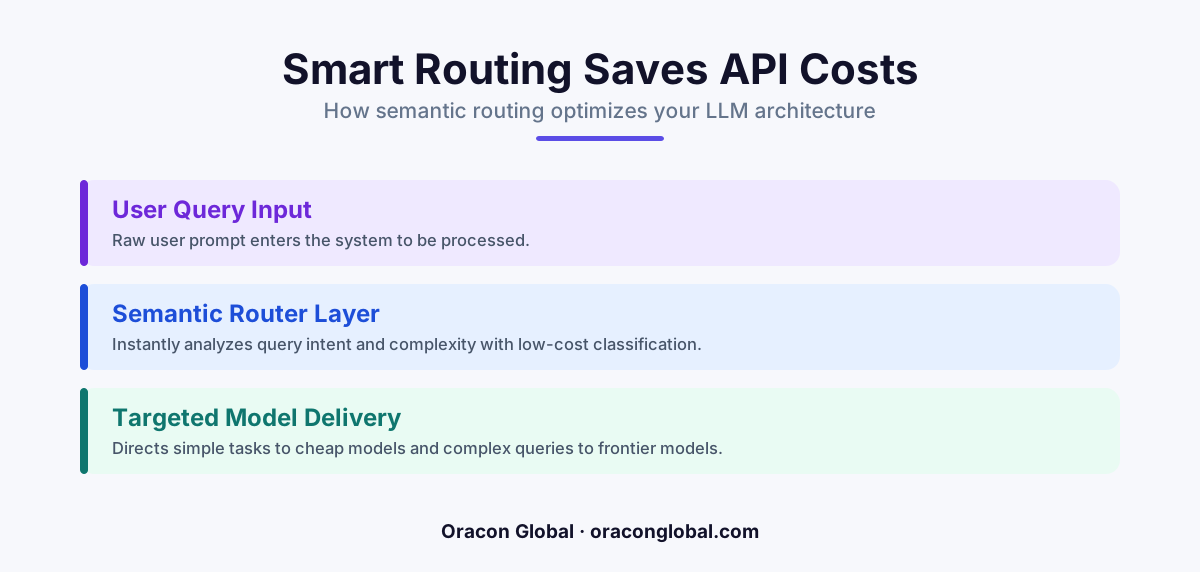
A semantic router layer sits between your user interface and your LLMs, evaluating the intent of an incoming query in milliseconds. By directing simple requests to lightweight models, cached responses, or hardcoded local scripts, it slashes cloud costs and eliminates unnecessary latency.
Many businesses building custom AI tools encounter a frustrating bottleneck shortly after launch: the system is either too slow, too expensive, or both. When you look under the hood, the root cause is almost always the same. The application is treating every single user interaction with the same level of heavy computational processing. Whether a user asks for a complex, multi-source financial audit or simply types "hello," the query is sent to a top-tier, expensive frontier large language model.
This approach is the engineering equivalent of hiring a team of specialized corporate lawyers to answer your office front-desk telephone. It is inefficient, highly expensive, and creates an unnecessary queue for the complex tasks that actually require that level of expertise.
To build a production-grade AI system that scales without draining your cloud budget, you need an intelligent traffic controller sitting at the front door. This is where a semantic router layer becomes essential to your enterprise AI architecture.
What Is a Semantic Router Layer?
A semantic router layer is a highly optimized, lightweight software component that sits directly between your user interface and your collection of AI models and databases. Instead of passing a user's prompt straight to an LLM, the semantic router analyzes the underlying intent of the text in milliseconds.
It does this by converting the incoming query into a vector embedding—a mathematical representation of its meaning—and comparing it against a pre-defined map of business routes. Depending on what the user is actually trying to accomplish, the router instantly directs the query to the single most efficient resource capable of handling it.
This resource might be:
- A hardcoded local Python script for basic calculations or formatting.
- A local semantic cache containing pre-approved answers to identical or highly similar questions.
- A fast, highly specialized, and inexpensive open-source model running locally.
- A premium frontier LLM, reserved exclusively for highly complex reasoning tasks.
How Semantic Routing Protects Your Tech Stack and Budget
Integrating a semantic router layer into your custom AI applications delivers immediate, measurable improvements across your entire operations pipeline. For founders and product operators, three primary benefits stand out.
1. Radical LLM Cost Optimization
Not every business query requires a model with hundreds of billions of parameters. If a customer asks, "What are your holiday hours?" or "Export this table to CSV," calling a premium API is a waste of capital. A semantic router detects these simple transactional intents and diverts them to local databases or basic code execution. This ensures you only pay premium token rates for premium reasoning tasks, leading to dramatic LLM cost optimization.
2. Sub-Second Latency Reduction
External LLM API calls are notoriously slow, often taking several seconds to return a complete response. A semantic router, running locally on your servers, can evaluate and route an incoming prompt in 10 to 30 milliseconds. If the router matches the query to a cached response or a local database query, the user receives an instantaneous answer, completely bypassing the external API queue.
3. Built-In Security and Compliance Guardrails
Because the semantic router inspects the semantic meaning of a prompt before it reaches any external models, it serves as an excellent security gateway. It can immediately identify and block prompt injection attacks, off-topic requests, or attempts to access restricted internal directories. The query is neutralized at the perimeter, keeping your core models safe and compliant.
Anatomy of a Production-Ready Routing Architecture
To understand how this functions in a live production environment, it is helpful to look at the step-by-step path a user prompt takes when interacting with a properly routed system.
- The Prompt Arrives: The user submits a query through your app's interface (for example, asking to check the status of a shipping invoice).
- Fast Vector Conversion: The query is instantly converted into a lightweight vector embedding using a fast, cost-efficient local model.
- Intent Classification: The system compares this vector against predefined clusters of business intents (e.g., "Account Management," "Data Export," "Complex Synthesis").
- The Routing Decision:
- If it matches Account Management, the router triggers a direct SQL database call. No LLM is used.
- If it matches Data Export, it initiates a local script that generates the requested file.
- If it matches Complex Synthesis, it packages the prompt with relevant data from your vector store and escalates it to a frontier LLM.
- The Response Return: The processed answer is returned to the user interface, utilizing the minimum amount of compute power required to achieve a perfect result.
"By treating prompt routing as a deterministic traffic engineering problem rather than a creative writing exercise, businesses can scale their AI applications to thousands of daily active users without watching their API bills scale linearly alongside them."
Integrating Semantic Routing with Your Custom AI Systems
Implementing a semantic router layer does not require you to tear down your existing software or rebuild your AI models from scratch. It is designed to sit cleanly as a middleware layer in your application backend.
At Oracon Global, our senior in-house engineering team designs and builds full-stack AI applications with these optimization layers built directly into the architecture from day one. Whether we are developing custom AI agents, AI-native ERP systems, or responsive mobile apps, we focus on creating software that you own entirely. When you work with us, you receive 100% of the code and intellectual property, ensuring your technology remains a permanent, proprietary asset for your business.
Build High-Performance AI That Scales
Building custom AI tools should make your operations more efficient, not introduce unpredictable cloud bills and sluggish user experiences. By taking control of how your prompts are processed, you ensure your software remains fast, secure, and highly cost-effective.
If you are planning a custom AI initiative, building an automated workflow, or looking to optimize an existing system that is running slow or proving too expensive to maintain, we can help you build the right architecture.
Would you like to discuss how to structure a custom AI application or routing layer for your specific business operations? Get in touch with our engineering team at Oracon Global today.
Frequently asked questions
What is a semantic router layer?
It is a lightweight architectural component that analyzes the meaning and intent of a user prompt before it reaches a large language model, routing the query to the most efficient processing path.
How does semantic routing reduce LLM API costs?
It prevents expensive frontier models from processing simple or repetitive queries by intercepting them and redirecting them to cheaper local scripts, cached answers, or smaller open-source models.
Does a semantic router add latency to AI applications?
No, because it uses ultra-fast, local vector math to check prompt intent, typically responding in under 10 to 15 milliseconds, which is far faster than calling an external LLM API.
Can a semantic router improve enterprise AI security?
Yes, it can identify and intercept off-topic questions, prompt injection attempts, or sensitive data queries before they are sent to external cloud APIs.
Read next
Beyond Chatbots: How to Build AI Agents That Actually Do Work for Your Business
Most businesses use AI to answer questions. Here is how to build custom AI agents that actually take action, connect to your internal tools, and handle complex workflows.
Beyond the Wrapper: How to Build Custom AI Agents for Business That Actually Work
Many businesses invest in basic AI wrappers only to find they lack the security and context needed for real work. Here is how to build custom AI agents that integrate deeply with your workflows and databases.
Enterprise AI Maintenance Costs: Budgeting for Year Two and Beyond
Building an AI system is only half the battle. Discover the practical, ongoing operational costs of enterprise AI, including token management, model drift, and continuous security audits.
Oracon Global builds production-grade AI agents, automation and apps — and you own the code and IP. Tell us what you want to automate.
Book a call →See our work