

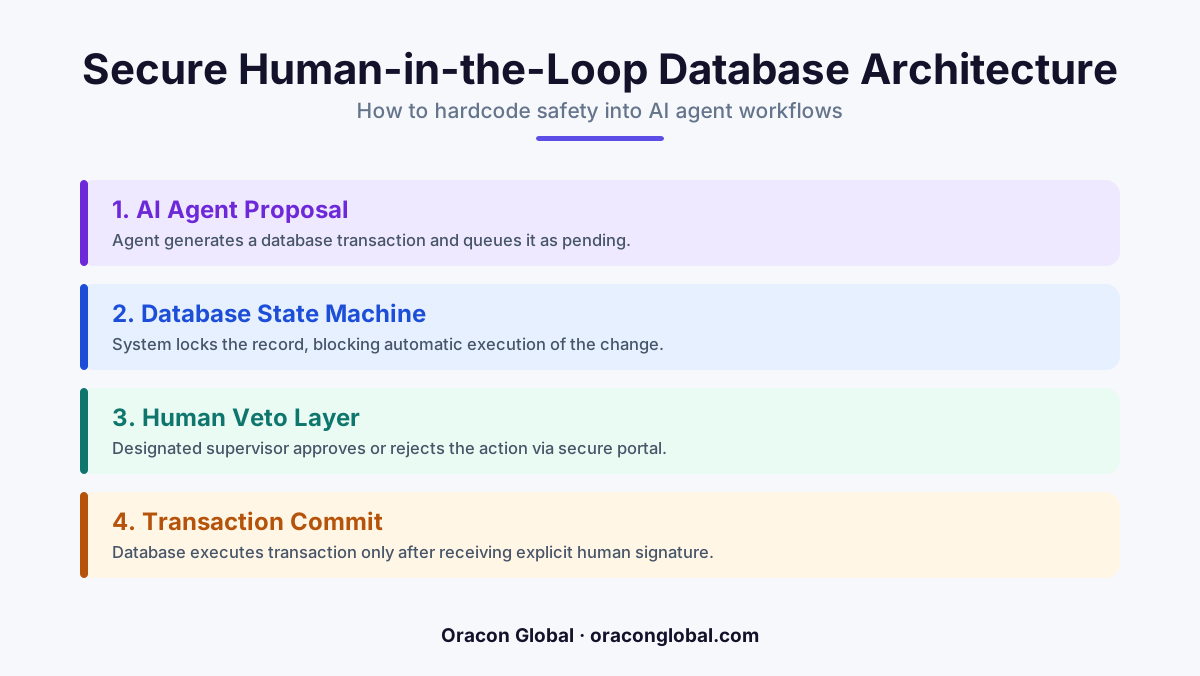
Relying on an LLM to voluntarily ask for human permission is a critical security vulnerability. To ensure true safety, your custom AI architecture must enforce human approval at the database level using a strict state machine, making unauthorized data mutations physically impossible.
When founders and operators design their first custom AI agent, they often focus entirely on the agent's reasoning capabilities. They write extensive system prompts, connect specialized toolkits, and establish fallback paths for when the LLM encounters a task it does not understand. The assumption is that if you tell an AI agent to stop and ask for permission before executing a critical task, it will do so.
In a production environment, relying on an LLM to police itself is a significant security risk. If a prompt injection occurs, or if the agent encounters an unexpected edge case, it can bypass its own internal instructions. To build truly secure, reliable enterprise systems, your next human-in-the-loop AI database design must move the approval gate out of the prompt layer and hardcode it directly into your application's database state machine.
By enforcing human veto power at the database level, you ensure that no matter how creative or confused an AI agent becomes, it physically cannot execute an unauthorized transaction, alter client data, or commit to a high-risk decision without explicit human sign-off.
The Structural Flaw of Prompt-Based Approvals
Most basic AI workflows rely on what is called "soft governance." The developer prompts the agent: "If the invoice total is over one thousand dollars, pause the execution and ask the user for approval."
For a demo, this works perfectly. But in real-world operations, this architecture introduces several vulnerabilities:
- Instruction Drift: As multi-step agentic loops run longer, the primary instruction to pause can lose priority in the context window.
- Hallucinatory Compliance: The agent may hallucinate that it already received human approval and proceed to call the execution API anyway.
- Direct API Bypassing: If an agent has direct write access to your system APIs, a minor logic error can trigger a database update without ever triggering the validation step.
To solve this, we must decouple the AI agent's reasoning from the database's state transitions. The database must treat the AI agent as an untrusted client, enforcing strict validation rules that only a human session can satisfy.
Understanding the Database State Machine
A database state machine is a software design pattern where a record can only transition between predefined statuses (such as Draft, Pending_Review, Approved, or Rejected) by following strict, hardcoded backend rules.
When you build this architecture for an AI digital employee, the agent does not actually perform the final action. Instead, the agent's sole capability is to write a record to the database in a Pending_Review state. It cannot transition that record to Approved. Only a human user, authenticated via a secure session, can trigger the API endpoint that transitions the record to Approved and triggers the downstream execution code.
"By decoupling the AI's reasoning from the database's state transitions, you eliminate the risk of an autonomous run-away loop. The system architecture itself becomes the ultimate guardrail."
How a Hardcoded Veto Pipeline Works
Implementing this pattern does not complicate your overall stack; it simply organizes your data flow to prioritize safety. Here is how a robust human-in-the-loop AI database pipeline operates in practice:
- The Agent Drafts the Action: The AI agent gathers data, performs its reasoning, and decides to execute an action (for example, generating a supplier purchase order).
- The Locked State Insertion: Instead of calling the supplier's external API, the agent writes the purchase order details to your database. The database automatically assigns this record a state of
Pending_Human_Approval. - The Database Guardrail: The database schema contains a constraint: any API call trying to send this purchase order to the supplier will throw a 500 error unless the record's state is changed to
Approved. Crucially, the AI agent's database user role does not have permission to write to theApprovedstate. - The Human Notification: Your application triggers a webhook to alert a human manager via a clean, simple dashboard UI.
- The Veto or Release: The human reviews the draft. If they approve, they click a button, their user credentials validate the state transition to
Approved, and the system executes the API call. If they veto it, the record is markedRejected, and the AI agent is prompted to try again with the human's feedback.
Designing for Enterprise AI Security
This state-machine architecture is a foundational pillar of modern enterprise AI architecture. It allows companies to deploy highly autonomous agents for complex work—such as inventory management, customer support escalations, and billing adjustments—without risking their operational integrity.
When you approach custom AI development with this mindset, you protect your business from API key abuse, data corruption, and accidental financial commitments. It allows you to scale your operations with digital employees while maintaining the exact same compliance and auditing standards you apply to your human staff.
Build Safe, Production-Ready AI Systems
At Oracon Global, our senior in-house engineering team builds custom web applications, AI-native ERPs, and highly secure AI digital employees from our base in India for clients worldwide. We focus on writing clean, production-grade code that you own completely. We do not rely on fragile no-code wrappers or soft prompt-based safety nets; we build robust backend architectures designed to scale safely under real-world pressure.
If you are planning your next enterprise AI integration and want to ensure it is built with enterprise-grade security and state-machine guardrails, we can help you design and deploy a solution that fits your exact workflow.
Would you like to discuss how to structure your database architecture to support safe, autonomous AI agents in your business?
Frequently asked questions
Why can we not just prompt the AI agent to ask for permission before taking an action?
Prompts are soft instructions that an LLM can bypass due to hallucinations, system instruction drift, or edge-case logic errors. Only database-level state constraints can guarantee an action is blocked until a human approves it.
What is a database state machine in the context of AI agents?
It is a backend system where data records can only transition from one status to another (such as pending to approved) through strictly defined, programmatically enforced database rules, independent of the AI's logic.
Does adding a database-level veto slow down the performance of the AI agent?
No, the AI agent continues to run its reasoning steps in real time. The database state machine simply holds high-risk mutations in a pending state until a human operator clicks approve, preserving both speed and safety.
What kinds of business actions require a hardcoded database veto?
Any action that involves moving money, changing inventory levels, updating customer contracts, sending mass communications, or altering sensitive user permissions should be protected by a database-level state machine.
Read next
Beyond Chatbots: How to Build AI Agents That Actually Do Work for Your Business
Most businesses use AI to answer questions. Here is how to build custom AI agents that actually take action, connect to your internal tools, and handle complex workflows.
Beyond the Wrapper: How to Build Custom AI Agents for Business That Actually Work
Many businesses invest in basic AI wrappers only to find they lack the security and context needed for real work. Here is how to build custom AI agents that integrate deeply with your workflows and databases.
Enterprise AI Maintenance Costs: Budgeting for Year Two and Beyond
Building an AI system is only half the battle. Discover the practical, ongoing operational costs of enterprise AI, including token management, model drift, and continuous security audits.
Oracon Global builds production-grade AI agents, automation and apps — and you own the code and IP. Tell us what you want to automate.
Book a call →See our work