

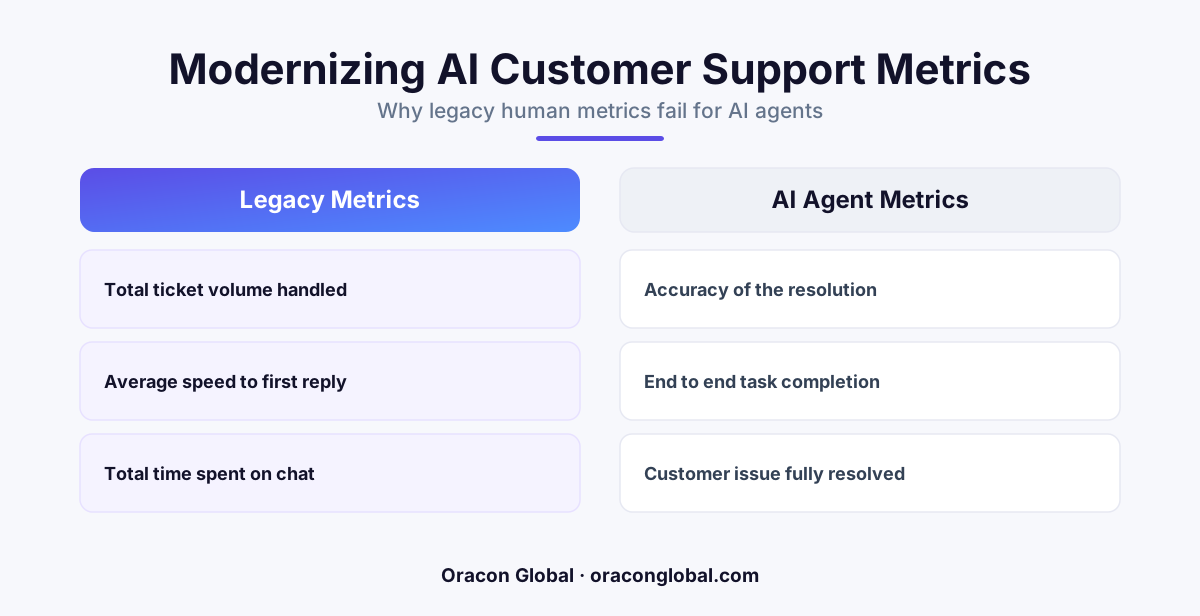
Legacy operations metrics like ticket volume reward rapid, superficial actions, which encourages poor AI behavior and silent execution failures. Transitioning to resolution accuracy as a primary KPI ensures AI agents actually solve user problems, lowering operational costs and stabilizing automated workflows.
For decades, customer service and operations teams have relied on a predictable set of metrics to measure success. We tracked ticket volume, average handling time, and the sheer number of closed cases per shift. These metrics worked well when human agents sat at the center of the workflow. In a human-driven system, speed and throughput are reliable indicators of team productivity.
But when you introduce an autonomous AI digital employee or custom AI agents into your business operations, these legacy metrics break down. If your team continues to measure AI performance using ticket volume, you will create a dangerous illusion of efficiency while actually increasing your operational overhead.
To capture the real value of automation, operations teams must make a fundamental shift: stop tracking how many tasks an AI agent touches, and start measuring resolution accuracy.
The Structural Flaw of Volume-Based Metrics
In a traditional operations setup, high ticket volume is often treated as a positive sign of a hard-working team. If an agent closes fifty tickets in a day, the dashboard turns green. However, AI agents do not suffer from fatigue, and they do not need to space out their workload. An AI agent can process five hundred tickets in seconds.
If your primary metric remains ticket volume, your AI system will technically achieve flawless performance on day one. It will process vast numbers of tickets instantly. But volume metrics do not tell you if the underlying problems were actually solved.
When an AI system is optimized purely for speed and throughput, it often results in what operators call "silent failures." The AI might quickly reply to a customer, tag the ticket as closed, and move to the next. But if the customer's issue was not actually resolved, they will open a new ticket an hour later. This creates an artificial spike in ticket volume, makes your dashboards look incredibly productive, and quietly overwhelms your human tier-two support team with escalations.
Why Resolution Accuracy Is the Only Metric That Matters for AI
Resolution accuracy measures the percentage of tasks that the AI agent completes correctly, end-to-end, without requiring human intervention or correction. It shifts the focus from how fast the work is done to how well it is executed.
When you build custom AI agents with an experienced development partner, you are not just building a faster email auto-responder; you are building an autonomous operator. To evaluate an autonomous operator, your measurement framework must adapt. Here is why resolution accuracy must become your primary operational KPI:
- It prevents loop behavior: An accurate AI agent resolves the core issue on the first attempt, stopping the endless loop of back-and-forth emails that inflates ticket numbers.
- It protects downstream databases: In workflows where AI agents write directly to your ERP or CRM, a volume-focused agent might write messy, unstructured data quickly. An accuracy-focused agent ensures data integrity before executing a database write.
- It reveals the true ROI of your build: Real operational savings do not come from sending more messages; they come from completely removing friction points from your business processes.
The High Cost of the "Quick Reply" Illusion
Consider an AI-native ERP system handling supplier invoice reconciliation. A volume-focused AI agent might quickly match one hundred invoices against purchase orders, marking them as processed. But if the matching logic was only 80% accurate, your accounting team will spend days untangling double payments and missing line items. In this scenario, high volume directly translated into high operational debt.
How to Restructure Your Operations Dashboard for AI Success
Transitioning your team away from legacy metrics requires a deliberate change in your reporting dashboards. You need to replace traditional speed metrics with guardrail-focused indicators. Start by tracking these three core metrics instead of raw ticket volume:
1. First-Contact Resolution (FCR) Rate
Track how often an AI agent resolves a query or completes a workflow in a single session without the user needing to follow up or ask for a human. A high FCR indicates that the AI agent's retrieval-augmented generation (RAG) pipeline is pulling the correct data and applying the right business logic on the first try.
2. Task Completion Accuracy
This metric measures how often the AI agent successfully executes an external API call or database update without triggering an error boundary. If your AI digital employee is tasked with updating shipping addresses in your logistics portal, task completion accuracy monitors whether those address fields were formatted and saved correctly without breaking legacy database rules.
3. Human Hand-off Precision
An AI agent should know its limits. Instead of trying to resolve a complex, highly sensitive query and failing, a smart AI agent will route the case to a human with a clear, structured summary of what has happened so far. Hand-off precision measures whether the AI routed the ticket to the correct human specialist on the first attempt, saving your team from manual triage.
Designing Your AI Agents for High-Accuracy Workflows
Shifting your KPIs is only half the battle; your underlying software architecture must also be designed to prioritize accuracy. At Oracon Global, our senior in-house development team builds AI systems from the ground up to prevent the errors that legacy systems ignore.
We do this by building custom state machines and deterministic business logic directly into the AI workflow. Instead of giving an LLM complete creative freedom to run wild across your databases, we enforce strict software guardrails. This ensures that the AI can only execute actions that are validated against your existing business rules, keeping your resolution accuracy incredibly high.
When you own 100% of the code and intellectual property of your custom build—as you do with every project Oracon Global delivers—your internal team can continuously audit, refine, and optimize these guardrails as your operational needs evolve.
Align Your Team with the Real Value of Automation
Deploying AI digital employees is one of the most effective ways to scale your business operations without linear hiring costs. But if you judge these digital employees by human shift-work metrics, you will miss the real opportunity.
Encourage your operations team to stop celebrating high ticket counts and start analyzing task precision. When your target is flawless execution rather than rapid output, your workflows stabilize, your customers receive better service, and your business captures the true, long-term ROI of custom AI development.
If you are ready to move past generic chatbot interfaces and build custom, high-accuracy AI agents tailored to your business operations, reach out to the senior team at Oracon Global today to discuss your project.
Frequently asked questions
Why is ticket volume a bad metric for measuring AI agents?
Ticket volume rewards the quantity of interactions rather than the quality of the outcome. When an AI agent is measured by ticket volume, it incentivizes fast, incomplete responses that close a ticket without actually resolving the underlying user problem.
What is resolution accuracy in the context of AI operations?
Resolution accuracy measures whether the AI agent completed the task correctly, adhered to business compliance rules, and fully solved the user query without requiring a human agent to reopen or correct the case.
How do legacy KPIs lead to hidden costs in AI deployments?
Measuring speed or volume over accuracy leads to silent failures, where AI agents repeatedly process incorrect data or send superficial replies. This forces human teams to spend time undoing mistakes, driving up operational overhead.
What metrics should we track instead of ticket volume?
Shift your focus to first-contact resolution rates, task completion accuracy, API execution success rates, and user-confirmed resolution metrics.
Read next
Beyond Chatbots: How to Build AI Agents That Actually Do Work for Your Business
Most businesses use AI to answer questions. Here is how to build custom AI agents that actually take action, connect to your internal tools, and handle complex workflows.
Beyond the Wrapper: How to Build Custom AI Agents for Business That Actually Work
Many businesses invest in basic AI wrappers only to find they lack the security and context needed for real work. Here is how to build custom AI agents that integrate deeply with your workflows and databases.
Enterprise AI Maintenance Costs: Budgeting for Year Two and Beyond
Building an AI system is only half the battle. Discover the practical, ongoing operational costs of enterprise AI, including token management, model drift, and continuous security audits.
Oracon Global builds production-grade AI agents, automation and apps — and you own the code and IP. Tell us what you want to automate.
Book a call →See our work