

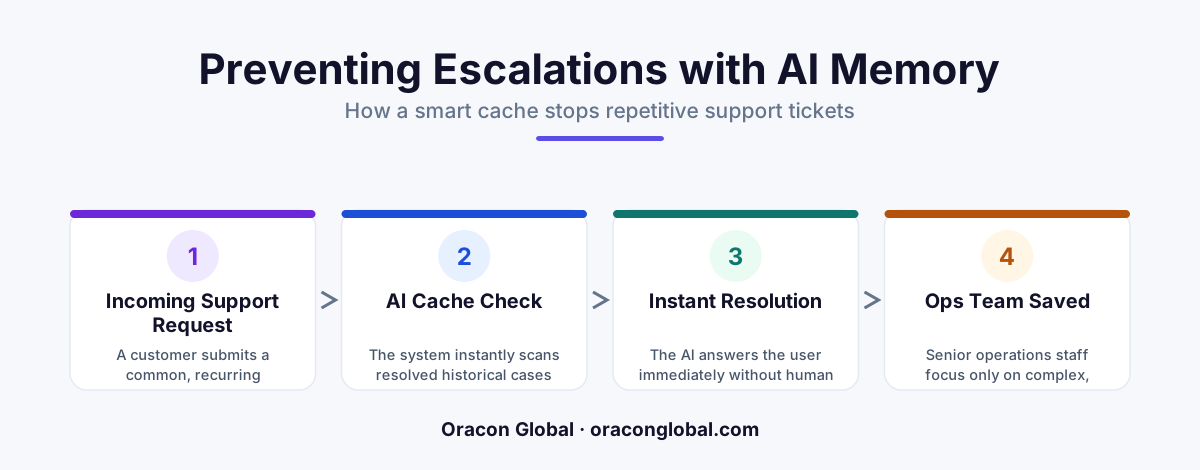
Repetitive support escalations happen because standard customer service software lacks a persistent, context-aware memory of previous resolutions. By implementing an AI memory cache, your operational system can instantly recognize, retrieve, and deploy past solutions to new, matching inquiries without routing them to human engineers.
Every operations leader knows the frustration of the recurring support loop. A customer encounters a complex technical edge case, files a ticket, and your frontline support team struggles to find the answer. The ticket escalates to a senior systems engineer, who spends thirty minutes digging through logs, finds the resolution, applies the fix, and closes the ticket.
Then, three days later, a different customer encounters the exact same edge case. The entire cycle repeats from scratch.
Despite having expensive ticketing systems, knowledge bases, and team wikis, your senior staff's time is continuously drained by repetitive customer support escalations. The root of the problem isn't a lack of documentation; it is a lack of active, accessible system memory. To break this cycle, forward-thinking operations teams are deploying a dedicated AI memory cache to capture, store, and deploy solutions the moment they are created.
The True Cost of Repetitive Customer Support Escalations
When a complex operational issue is resolved, the solution usually ends up buried in a closed Slack thread, an obscure Jira ticket, or the mind of a single engineer. Traditional support architectures simply are not designed to surface these hyper-specific solutions when a similar issue arises. This structural gap impacts your business in several distinct ways:
- Senior Talent Drain: Your highest-paid engineers and operations managers spend their days answering variations of the same five questions instead of building core product features or scaling infrastructure.
- Skyrocketing Resolution Times: Customers wait hours or days for an escalation queue to clear, even when the exact fix for their problem was discovered and executed last week.
- Institutional Knowledge Loss: When an experienced operations team member leaves your company, they take years of undocumented edge-case solutions with them, leaving your support team vulnerable.
To solve this, businesses need a system that doesn't just store documents, but actively remembers resolutions and applies them in real time to improve operational efficiency.
What Is an AI Memory Cache?
An AI memory cache is an intelligent database layer that sits between your customer-facing communication channels and your backend operations team. Unlike static help articles, which require manual writing and categorizing, the memory cache automatically indexes real-time resolutions as they happen.
When a human operator resolves a unique escalation, the AI agent analyzes the ticket history, extracts the core problem and the exact steps taken to solve it, and stores this relationship as a highly structured, searchable memory. The next time a customer describes a similar issue—even if they use completely different phrasing—the cache intercepts the ticket, retrieves the proven resolution, and offers to solve it immediately.
This process transforms passive historical data into active, preventative system intelligence, allowing AI digital employees to handle complex troubleshooting workflows autonomously.
How the Memory Cache Intercepts and Resolves Escalations
Implementing an AI memory cache changes the entire lifecycle of a customer support ticket. Instead of immediately routing an unrecognized issue to a human agent, the system follows a highly efficient, automated retrieval workflow:
Step 1: Semantic Evaluation of the Incoming Ticket
When a new ticket arrives, the system does not look for exact keyword matches. Instead, it converts the user's query into a mathematical representation called a vector. This allows the AI to understand the core intent of the issue, recognizing that "My dashboard is completely blank after I updated my profile" and "The portal won't load anything following my account changes" refer to the exact same underlying problem.
Step 2: Checking the Active Cache Layer
The system queries the AI memory cache for previously resolved tickets with high semantic similarity. If a match is found, the system pulls the exact technical resolution steps, database queries, or settings adjustments that successfully resolved the issue in the past.
Step 3: Safe, Context-Aware Execution
Rather than blindly copying the past solution, the AI reviews the current customer's environment parameters to ensure the fix is safe to apply. Once validated, it draft the step-by-step resolution for the customer, or, if permitted by your workflow automation rules, executes the adjustment in the backend system automatically.
Key Benefits of This Architecture for Operations Leaders
By moving from manual escalation queues to an active caching model, operations teams achieve measurable improvements in both team performance and customer satisfaction.
First, it delivers a dramatic reduction in ticket volume. By deflecting repetitive support tickets before they reach your primary queue, your frontline team can focus on personalized, high-touch customer care.
Second, it establishes a self-learning operational loop. Every time a human engineer resolves a brand-new, complex edge case, the system's memory grows more robust. Your support infrastructure literally becomes smarter with every ticket resolved, transforming your operational knowledge into a permanent digital asset.
Finally, it ensures absolute consistency. Customers receive the same precise, verified technical instructions regardless of which team member is on shift, eliminating the human error associated with misremembered or outdated workarounds.
Building Your Custom Operational AI Layer
At Oracon Global, we build custom AI agents, workflow automation pipelines, and native apps that help businesses scale their operations without ballooning headcount. Our senior, in-house team designs, develops, and deploys high-performance AI architectures tailored to your specific business systems. Best of all, we believe in true ownership: you retain 100% of the code and intellectual property we build for you.
Ready to reclaim your senior team's time and stop answering the same customer questions over and over?
Contact the team at Oracon Global today to discuss how we can build a custom AI memory cache for your operations team.
Frequently asked questions
What is an AI memory cache in customer support?
It is a specialized, fast-access data layer that stores previous complex resolutions resolved by senior staff, allowing AI agents to instantly resolve matching future tickets without human routing.
How does this differ from a traditional internal knowledge base?
A static knowledge base requires manual updates and human searching, whereas an AI memory cache automatically captures real-time resolutions and proactively applies them to incoming requests.
Will this replace our existing customer support ticketing platform?
No, it integrates directly with your existing CRM or ticketing tool as an intelligent middleware layer that intercepts and resolves repetitive tickets before they reach human queues.
How difficult is it to set up an AI memory cache?
With a professional development team, it involves connecting your ticketing API to a dedicated vector storage layer and configuring retrieval guardrails, which can be deployed in a few weeks.
Read next
Beyond Chatbots: How to Build AI Agents That Actually Do Work for Your Business
Most businesses use AI to answer questions. Here is how to build custom AI agents that actually take action, connect to your internal tools, and handle complex workflows.
Beyond the Wrapper: How to Build Custom AI Agents for Business That Actually Work
Many businesses invest in basic AI wrappers only to find they lack the security and context needed for real work. Here is how to build custom AI agents that integrate deeply with your workflows and databases.
Enterprise AI Maintenance Costs: Budgeting for Year Two and Beyond
Building an AI system is only half the battle. Discover the practical, ongoing operational costs of enterprise AI, including token management, model drift, and continuous security audits.
Oracon Global builds production-grade AI agents, automation and apps — and you own the code and IP. Tell us what you want to automate.
Book a call →See our work