

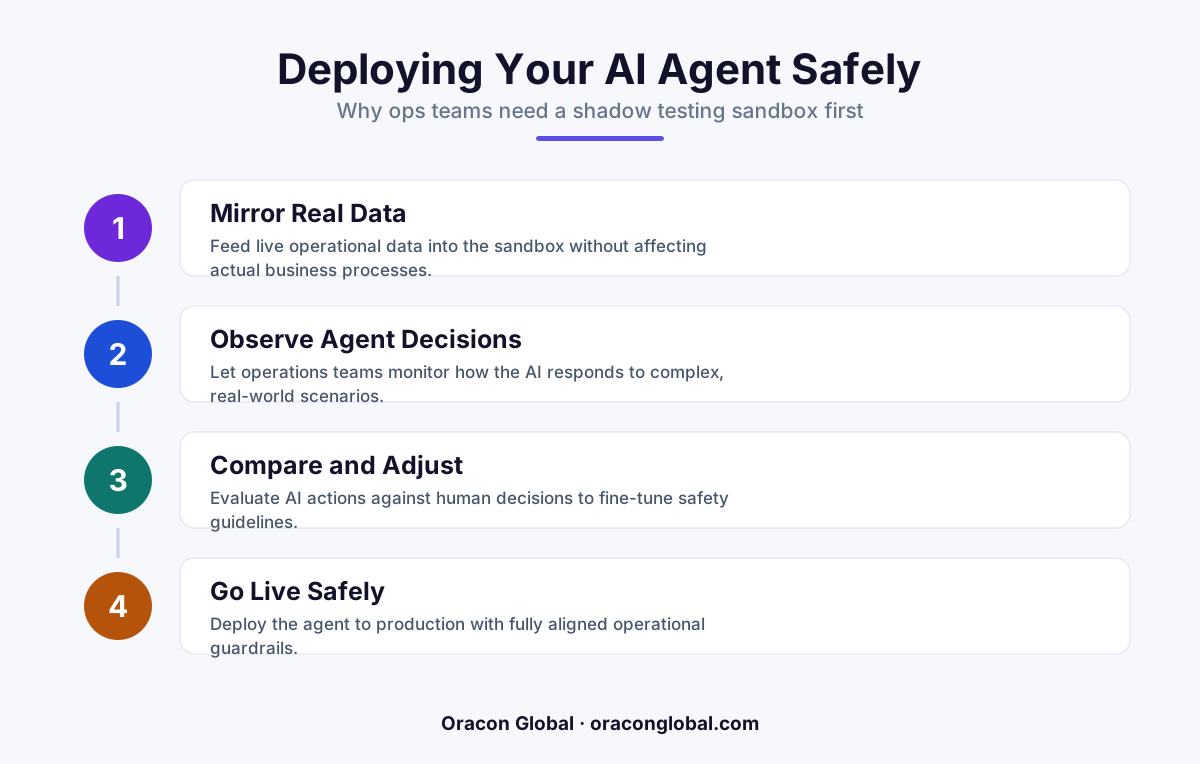
An AI shadow testing sandbox allows your operations team to run a new AI agent in parallel with live workflows without executing real-world actions. This reveals edge cases, calibration issues, and hidden workflow friction before the software goes live.
When you build a custom AI agent to handle complex business operations, the temptation is to push it live the moment the developers complete their integration tests. The code compiles, the API endpoints connect, and the initial demonstrations look flawless. However, there is a massive difference between a software system that functions technically and an automated colleague that makes correct operational decisions under pressure.
For your operations team, a sudden transition from manual work to autonomous AI execution is a major risk. To bridge this gap safely, your business needs an AI shadow testing sandbox. This dedicated staging sandbox for AI allows your team to observe the agent working in parallel with real workflows, evaluating its decision-making quality before it ever touches a live customer or database write.
The Gap Between Technical QA and Operational Reality
Traditional software development relies on quality assurance (QA) to find bugs, broken links, and database errors. If the database saves a record correctly, the QA test passes. But AI agents do not just move data; they make qualitative decisions. They interpret ambiguous emails, categorize complex shipping documents, and determine whether a customer qualifies for a refund.
An engineer's test suite cannot predict how your operations team handles a vendor who submits an invoice with non-standard formatting, or how a customer phrases an unusual service request. Without an operational staging sandbox for AI, these real-world variations can lead to unexpected behavior on day one. A shadow testing sandbox allows your team to see exactly what the AI would have done, without the risk of actual execution.
How an AI Shadow Testing Sandbox Works
A shadow sandbox operates on a simple principle: live inputs, simulated outputs. The system is designed to copy real-time business data into an isolated environment where the AI agent can process it freely. Here is how the workflow functions in practice:
- Data Mirroring: Live incoming data—such as customer emails, support tickets, or inventory updates—is duplicated. One copy goes to your human operations team as usual; the other copy goes to the AI agent.
- Silent Execution: The AI agent processes the data, calls its integrated toolkits, and generates its final decision or action payload.
- Action Interception: Instead of sending the email, updating the ERP, or releasing the payment, the sandbox intercepts the action and saves it to a secure review log.
- Side-by-Side Comparison: Your operations team can view the live human action right next to the simulated AI action to check for alignment.
The Operations Review Interface
To make this sandbox useful, your team does not need to read raw code or database logs. At Oracon Global, we build clean, intuitive review interfaces for our clients' operations teams. These dashboards display the incoming request, the step-by-step reasoning of the AI agent, and the proposed action. Operators can easily mark decisions as "Approved," "Modified," or "Rejected," providing a clear feedback loop that helps refine the system before release.
Three Operational Risks You Avoid by Shadow Testing
Skipping this parallel testing phase puts an unnecessary burden on your team and your brand reputation. Utilizing a staging sandbox for AI helps mitigate three critical business risks:
1. Hallucinations in Edge Cases
Large language models perform exceptionally well on common, standardized requests. However, every business has rare edge cases that represent a tiny fraction of total volume but carry high operational risks. Shadow testing exposes how your AI agent behaves when faced with these unusual scenarios, allowing your development team to build hardcoded guardrails before launch.
2. Tone and Communication Alignment
If your AI agent communicates directly with external vendors or customers, the voice must align perfectly with your corporate guidelines. Reading the agent's drafted communications in a shadow log allows your communications and operations teams to adjust the prompt styling, constraints, and vocabulary in a real-world context.
3. Integrations and API Timing Issues
An AI agent often interacts with multiple third-party legacy APIs. In a live environment, APIs can be slow, rate-limited, or occasionally unresponsive. Running a shadow test over several weeks reveals how the agent handles these technical bottlenecks and whether its built-in error recovery mechanisms work smoothly under load.
Empowering Your Team to Trust the Technology
Operational risk management is not just about code; it is about human trust. When a company introduces autonomous AI agents, employees are often skeptical about relying on a machine to perform critical tasks. This skepticism is healthy—it protects your business from costly errors.
By involving your operations team in the shadow testing process, you turn them from passive observers into active trainers. They gain firsthand experience watching the AI agent handle complex tasks successfully day after day. By the time you transition the agent from shadow mode to live execution, your team will have full confidence in its capabilities because they helped refine its decision-making parameters.
Building Your Path to Safe Deployment
Deploying AI agents safely does not require slowing your innovation down; it simply requires a structured approach to risk. A shadow testing sandbox is a practical, high-yield investment that ensures your custom software delivers immediate value without operational disruptions.
At Oracon Global, our senior in-house development team builds custom AI agents, AI-native ERP systems, and secure workflow automation designed for real-world operations. We ensure every system we ship comes with the necessary sandboxes, approval gates, and management interfaces to keep your business running smoothly. Our clients retain 100% ownership of their code and intellectual property from day one.
If you are ready to explore how custom AI automation can optimize your business operations safely, contact Oracon Global today to schedule a consultation with our senior team.
Frequently asked questions
What is an AI shadow testing sandbox?
It is a isolated staging environment where an AI agent receives real business data and processes it in real time, but its actions are intercepted and logged rather than executed.
How does shadow testing differ from traditional software QA?
Traditional QA tests if code runs without crashing; shadow testing evaluates the quality, logic, and operational safety of the AI agent's decisions against live, unpredictable business scenarios.
Do we need technical developers to manage the sandbox?
While developers set up the infrastructure, the sandbox is designed for business operations teams to review, grade, and approve the agent's decisions using a simple dashboard.
How long should we run an AI agent in shadow mode?
Most operations teams run shadow testing for two to four weeks, allowing the agent to encounter a representative cycle of weekly business anomalies and edge cases.
Read next
Beyond Chatbots: How to Build AI Agents That Actually Do Work for Your Business
Most businesses use AI to answer questions. Here is how to build custom AI agents that actually take action, connect to your internal tools, and handle complex workflows.
Beyond the Wrapper: How to Build Custom AI Agents for Business That Actually Work
Many businesses invest in basic AI wrappers only to find they lack the security and context needed for real work. Here is how to build custom AI agents that integrate deeply with your workflows and databases.
Enterprise AI Maintenance Costs: Budgeting for Year Two and Beyond
Building an AI system is only half the battle. Discover the practical, ongoing operational costs of enterprise AI, including token management, model drift, and continuous security audits.
Oracon Global builds production-grade AI agents, automation and apps — and you own the code and IP. Tell us what you want to automate.
Book a call →See our work