

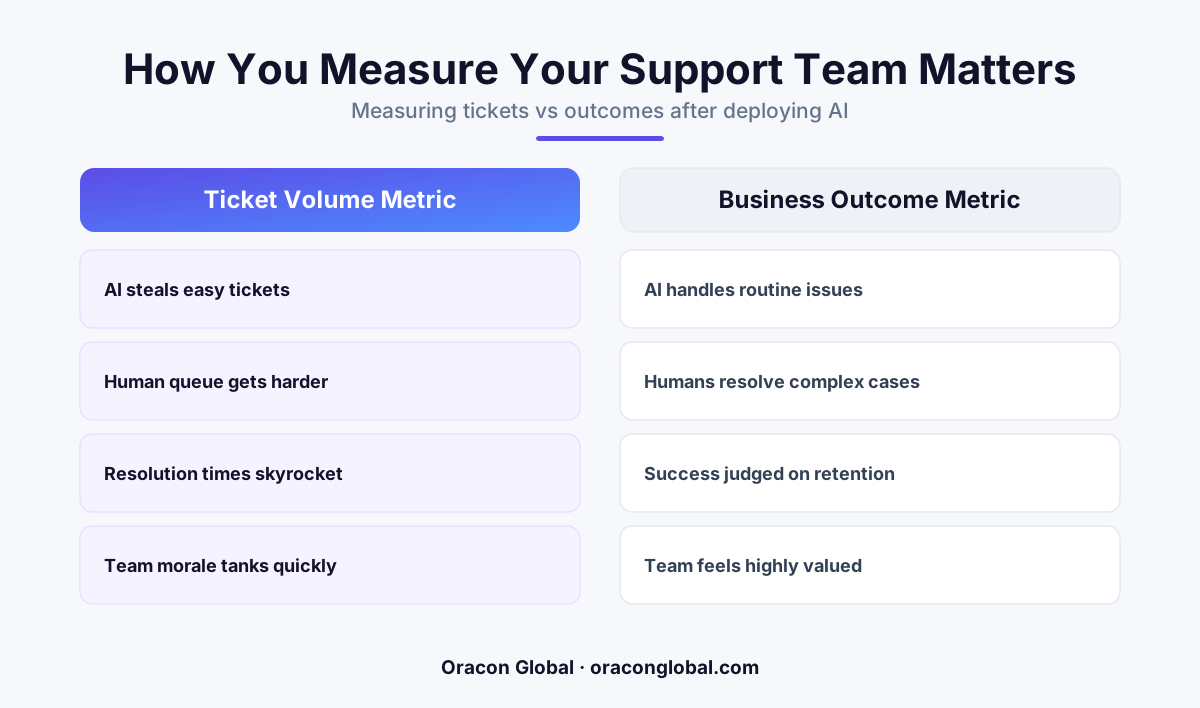
Introducing an AI agent that successfully resolves high volumes of simple, repetitive tasks leaves your human operations team with only the most complex, time-consuming issues. If you continue to measure their performance based on traditional metrics like tickets closed per hour, their productivity will appear to plummet, leading to resentment and resistance toward the new technology.
When you deploy a custom AI agent to assist your operations team, the goal is simple: reduce the burden of repetitive tasks, cut response times, and let your human staff focus on higher-value work. On paper, it sounds like a win-win scenario. The business saves money, and your team gets to shed the boring, repetitive tasks they dislike.
Yet, in many businesses, the launch of a highly capable AI digital employee is met with quiet resistance, frustration, and a sudden drop in employee morale. The issue is rarely the technology itself. Instead, the friction comes from a fundamental misalignment in how you measure the success of your people.
If you introduce a system that automatically resolves 60% of your incoming volume but continue to evaluate your operations team KPIs based on traditional metrics like tickets closed, you are setting your team up to fail. Here is why your team will hate your new AI agent if you do not change how you measure success.
The Simple Ticket Paradox
Before deploying an AI agent, a typical customer support or operations queue is a mix of easy, medium, and difficult tasks. A human agent's daily volume is naturally cushioned by quick wins. These are the password resets, the "where is my order" queries, and the basic subscription updates. These simple tasks take less than two minutes to resolve, allowing your team to keep their average resolution times low and their total ticket counts high.
When you build and deploy an AI agent, those quick wins disappear from the human queue. A well-designed agent handles those simple, repetitive tasks instantly and flawlessly in the background.
Suddenly, the queue of work landing on your human team's desks looks completely different. Every single ticket that reaches a human operator is now a complex, multi-layered problem. It is the customer with a unique billing edge case, the system integration failure, or the frustrated client who has already tried the standard troubleshooting steps. These issues cannot be solved in two minutes. They require deep research, cross-department coordination, and critical thinking.
Why Legacy Metrics Punish Your Best People
If your management team is still looking at traditional dashboards, the sudden shift in ticket complexity will look like a disaster. Under legacy metrics, your operations team will suddenly appear slower, less efficient, and less productive. Consider how these common metrics break down in an AI-assisted environment:
- Tickets Closed per Hour: This metric will plummet because humans are only handling complex cases that require deep diagnostic work.
- Average Handling Time (AHT): This number will spike dramatically. Without easy tickets to balance out the average, the mean time to resolve a ticket will climb.
- First-Contact Resolution (FCR): Because human agents are only receiving issues that have already failed automated resolution, the likelihood of resolving them on the first touch decreases.
If your team's quarterly bonuses, performance reviews, or job security are tied to these numbers, they will quickly realize that the new AI agent is actively hurting their career prospects. The tool that was supposed to help them has instead stripped away the easy work that kept their performance metrics looking green.
Shifting Focus to Business Outcomes
To successfully integrate an AI agent into your workflow, leadership must transition from tracking activity to measuring business outcomes. Your team is no longer a triage unit clearing out a high-volume inbox; they are now specialized problem solvers managing high-value exceptions.
When updating your operations team KPIs, consider shifting your focus to metrics that reflect true operational health and customer retention:
1. Net Promoter Score and Customer Satisfaction
Because your team has more time to dedicate to difficult cases, the quality of human support should rise. Track the satisfaction scores of the complex tickets that make it to your human team, rather than the overall average of all tickets.
2. Escalation Prevention Rate
Measure how effectively your senior staff resolves complex issues so they do not have to be escalated to engineering, product, or account management teams. A single well-resolved edge case is worth far more than fifty automated password resets.
3. Process Improvement and Feedback Loops
Your operations team is now in a unique position to spot systemic product or process issues. Reward team members who identify why certain tickets are bypassing the AI agent and work to optimize the underlying business rules or systems.
Aligning Your Team for Long-Term Success
Getting your team to embrace AI digital employees requires transparency and a deliberate update to your operational playbook. Before the technology goes live, sit down with your team and clarify how their roles are changing. Explain that you expect their daily ticket volumes to drop and their average resolution times to increase, because they are finally being freed up to do the deep, high-value work they were hired to do.
When you align your operational metrics with the actual value your team provides, you turn potential resistance into enthusiastic adoption. Your team will stop viewing the AI agent as a threat to their performance reviews and start seeing it for what it actually is: the ultimate support tool that lets them focus on meaningful work.
At Oracon Global, we design and build custom AI agents, digital employees, and custom software architectures that fit seamlessly into your existing operations. We help you build the systems, integration layers, and workflows needed to scale your business safely. Contact Oracon Global today to discuss how we can help you build custom AI solutions that your team will actually love to use.
Frequently asked questions
Why does deploying an AI agent make my operations team look less productive?
An AI agent instantly resolves the easy, quick-to-fix customer tickets. This leaves only the highly complex, multi-step problems for your human staff, which naturally take much longer to resolve and lower their total ticket count.
What metrics should I use instead of tickets closed?
You should focus on business outcomes such as first-contact resolution rates for complex issues, customer satisfaction scores, total cost to resolve an issue, and overall system retention.
How can we prevent staff from resisting new AI implementations?
You must align their performance incentives with the new reality of their workload by updating their KPIs before the AI agent goes live, ensuring they are rewarded for deep problem-solving rather than high-volume speed.
Does an AI agent replace the need for an operations team?
No, it shifts their focus. The AI handles the high-volume, low-complexity tasks, allowing your human experts to act as specialized problem solvers who handle high-value customer relationships and complex edge cases.
Read next
Beyond Chatbots: How to Build AI Agents That Actually Do Work for Your Business
Most businesses use AI to answer questions. Here is how to build custom AI agents that actually take action, connect to your internal tools, and handle complex workflows.
Beyond the Wrapper: How to Build Custom AI Agents for Business That Actually Work
Many businesses invest in basic AI wrappers only to find they lack the security and context needed for real work. Here is how to build custom AI agents that integrate deeply with your workflows and databases.
Enterprise AI Maintenance Costs: Budgeting for Year Two and Beyond
Building an AI system is only half the battle. Discover the practical, ongoing operational costs of enterprise AI, including token management, model drift, and continuous security audits.
Oracon Global builds production-grade AI agents, automation and apps — and you own the code and IP. Tell us what you want to automate.
Book a call →See our work