

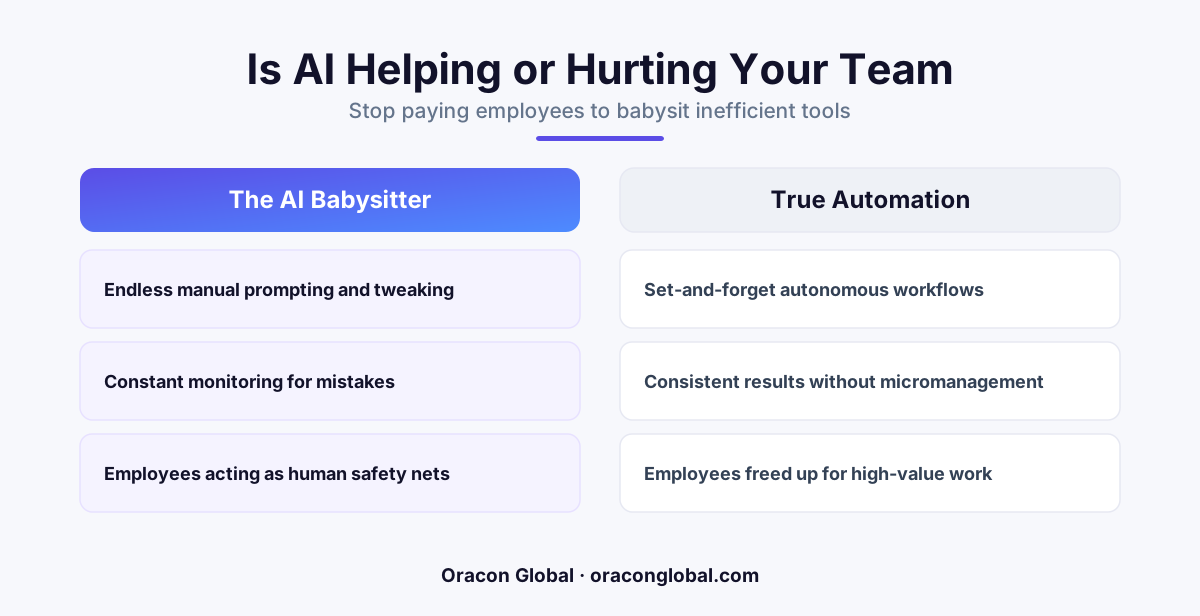
Many businesses deploy brittle AI wrappers that require constant human supervision to prevent errors. True automation requires custom, stateful AI digital employees built with hardcoded business logic, resilient error handling, and robust integration layers.
It was supposed to save your operations team twenty hours a week. Instead, your senior account managers are spending their afternoons double-checking draft emails, correcting database entries, and rewriting prompts. They are exhausted, your operational throughput has stalled, and your payroll is still funding manual labor—it has just been rebranded as prompt engineering.
This is the hidden tax of brittle AI adoption. When companies rush to deploy simple wrappers or pre-packaged bots, they often inadvertently create a new job description: AI Babysitter. If your team cannot trust your AI digital employees to execute a task from start to finish without constant oversight, you have not built automation. You have built an expensive digital toddler.
To fix this, we need to understand why these systems fail in production and how to build resilient, truly autonomous software that allows your human team to focus on high-value work.
The Illusion of Automation: Brittle Wrappers vs. Production Software
The marketplace is flooded with no-code tools promising instant workflow automation. While these platforms make for excellent weekend demonstrations, they rarely survive contact with real-world business data. They fail because they rely almost entirely on the hope that a large language model (LLM) will behave perfectly every single time.
In reality, business operations are messy. Databases contain formatting inconsistencies, legacy APIs drop connections, and customers ask unpredictable questions. When a simple AI wrapper encounters these minor deviations, it does one of two things: it crashes silently, or it hallucinates a plausible-sounding mistake.
Because these systems lack structural resilience, managers quickly realize they cannot leave the AI unattended. They introduce manual approval steps at every turn. Soon, your highly paid team is stuck reading logs, clicking approval buttons, and manually correcting fields. The core promise of software—leverage—is completely lost.
Why AI Agent Maintenance Is Draining Your Operational Budget
High AI agent maintenance costs usually stem from a lack of clean software engineering beneath the AI layer. When an agent is built without a robust architectural foundation, your team ends up paying the price in three distinct ways:
- The Prompt Tuning Loop: Every time the AI makes a mistake, your team edits the system prompt. This fixes the immediate bug but inevitably breaks three other behaviors elsewhere in the workflow.
- Manual Data Hand-offs: If your AI cannot write directly to your database or legacy ERP because of security fears, your team has to act as human bridges—copying text from a chat window and pasting it into your internal software.
- Context Switching Fatigue: Instead of focusing on deep, strategic tasks, your operators are constantly interrupted by notifications asking them to review simple draft responses or confirm straightforward routing decisions.
To stop this drain on your resources, your business needs to transition from fragile, prompt-heavy setups to structured, custom-engineered systems.
Building Autonomous Workflows That Actually Run Themselves
True automation does not mean giving an LLM free rein over your business operations. It means building a rigid digital track for the AI to run on. At Oracon Global, our senior in-house team builds systems that balance artificial intelligence with deterministic code.
1. Deterministic State Machines
An AI agent should never guess what its next step is. By wrapping the AI within a hardcoded state machine, we ensure the agent can only transition from Step A to Step B once specific, verifiable conditions are met. If a customer address is missing, the system doesn't guess; it programmatically halts the workflow and triggers a targeted follow-up.
2. Asynchronous Exception Routing
Your human team should not be watching the AI work. Instead, they should only interact with the system when an exception occurs. If the AI encounters a high-value contract or an irregular billing scenario, the system automatically routes the task to a human-in-the-loop dashboard. The human resolves the single block, and the AI resumes its autonomous run.
3. Secure Legacy System Integration
A productive digital employee must be able to read and write data where your business already operates. Rather than relying on fragile manual updates, custom integrations allow the AI to safely query databases, update CRM pipelines, and log inventory shifts in real time. Your team reads the final log, not the mid-process drafts.
How to Audit Your Systems for AI Babysitting
If you suspect your organization is paying a babysitting tax, ask yourself these three diagnostic questions:
- Does the tool work without a human in the room? If you turned off human review for 48 hours, would your operations collapse, or would they continue running smoothly with minimal error?
- Is your team copying and pasting? If a human is acting as the API between your AI tool and your core database, you have an integration gap, not an AI capability problem.
- Are your training sessions focused on software or prompt writing? If your staff is spending hours learning how to gently coax the AI into doing its job, your software architecture is incomplete.
If your answers point to a reliance on constant human supervision, it is time to move past basic prompt wrappers and invest in production-grade software.
Get Real Software Leverage with Oracon Global
Automation is supposed to free your team, not give them a new digital administrative assistant to manage. At Oracon Global, we design and build robust, custom AI agents, web apps, and enterprise systems that deliver true operational leverage. Our senior in-house developers write clean, production-ready code that your business owns completely, ensuring you retain 100% of your IP.
If you are ready to stop babysitting your software and start scaling your operations, visit our website to explore our live demos, chat with our site assistant, Aria, or get in touch with our team today to discuss your project.
Frequently asked questions
Why do our AI agents require constant human supervision?
Most off-the-shelf AI tools lack state management and rigid business logic boundaries. Without these architectural guardrails, the AI easily goes off track, forcing your team to constantly review and correct its outputs.
What is the difference between a chatbot and an AI digital employee?
A chatbot simply responds to prompts in a window and requires a human to copy-paste data. An AI digital employee runs in the background, connects directly to your databases, and executes multi-step workflows autonomously.
How do we stop our team from having to babysit our AI tools?
You must move away from simple prompt-based wrappers and invest in custom engineering. This includes building deterministic state machines, automated error-handling queues, and secure API integration layers.
Does building a robust AI agent mean we lose 100% of our human control?
Not at all. A well-designed agent uses an asynchronous human-in-the-loop framework, routing only highly complex exceptions to your team while executing standard, everyday tasks with complete autonomy.
Read next
Beyond Chatbots: How to Build AI Agents That Actually Do Work for Your Business
Most businesses use AI to answer questions. Here is how to build custom AI agents that actually take action, connect to your internal tools, and handle complex workflows.
Beyond the Wrapper: How to Build Custom AI Agents for Business That Actually Work
Many businesses invest in basic AI wrappers only to find they lack the security and context needed for real work. Here is how to build custom AI agents that integrate deeply with your workflows and databases.
Enterprise AI Maintenance Costs: Budgeting for Year Two and Beyond
Building an AI system is only half the battle. Discover the practical, ongoing operational costs of enterprise AI, including token management, model drift, and continuous security audits.
Oracon Global builds production-grade AI agents, automation and apps — and you own the code and IP. Tell us what you want to automate.
Book a call →See our work