

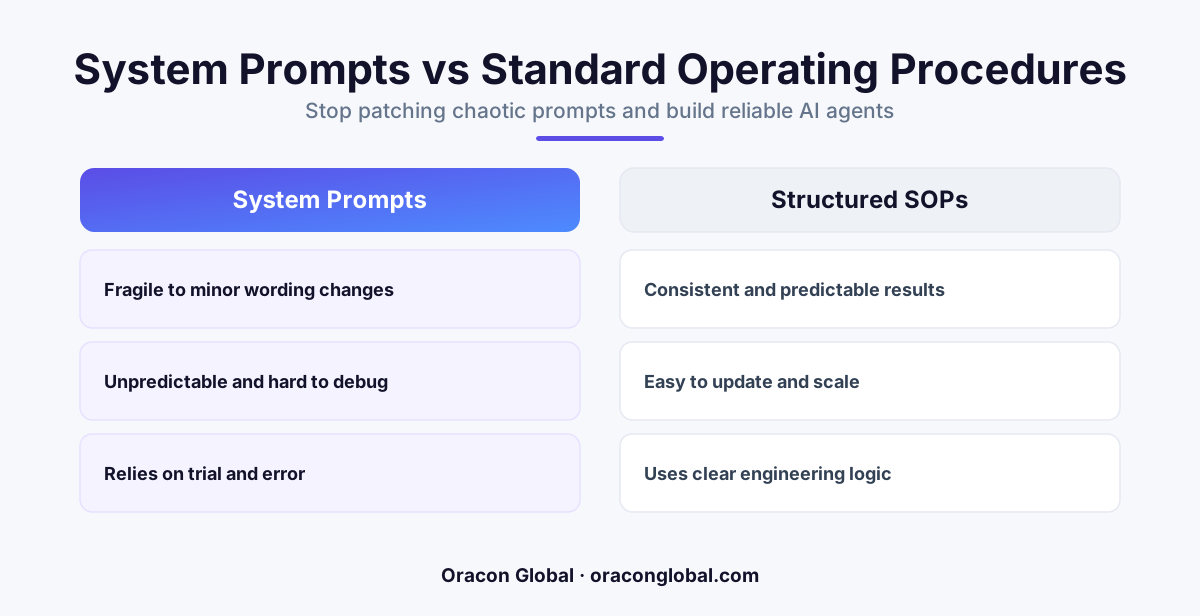
Relying on massive, complex system prompts to guide AI agents creates brittle systems that break with minor model updates. The solution is translating your operational workflows into structured, code-based Standard Operating Procedures (SOPs) that enforce deterministic steps before the LLM even runs.
Walk around almost any operations team trying to adopt AI today, and you will find someone playing the role of the "prompt whisperer." They are staring at a 2,000-word system prompt, gently editing adjectives, adding CAPS LOCK warnings, and pleading with an LLM to stop processing invoices out of order or emailing customers too early.
It feels like progress because a slight tweak to a system prompt can temporarily fix a bug. But in reality, your team is building a house of cards. They are using natural language prompts to do the job of system architecture.
When you rely on system prompts to enforce business logic, you are asking a probabilistic engine to act like deterministic code. To build reliable AI tools that scale, your team needs to stop writing endless system prompts and start building structured Standard Operating Procedures for AI.
The Brittle Reality of the Mega-Prompt
A system prompt is essentially a block of instructions telling an AI how to behave. In the early days of building a proof-of-concept, writing a detailed prompt is fine. It gets a demo running in an afternoon.
But as soon as that tool hits production, the limits of system prompts vs SOPs become painfully clear. When you pack all your business logic into a single text block, several things go wrong:
- The Whack-A-Mole Problem: You edit the prompt to fix Error A, only to discover that the edit accidentally caused the AI to forget how to handle Error B.
- Model Drift Vulnerability: Cloud LLM providers constantly update their underlying models. A prompt that worked perfectly on Friday can start failing on Monday because the model now interprets your adjectives slightly differently.
- No Audit Trail: When an AI steps outside of a system prompt, you cannot easily trace which sentence of the prompt failed or why. You are left guessing.
True operational scale requires predictable software behavior. If human operators need clear, step-by-step instructions to do their jobs, your AI digital employees need the exact same structure.
What Are Standard Operating Procedures for AI?
In a traditional business, an SOP is not a vague essay about "being professional." It is a checklist: If Event A happens, verify Document B, log the data in System C, and notify Person D.
In AI agent workflow design, an SOP is a state machine built in code. It divides a complex business process into small, isolated, deterministic steps. Instead of asking a single AI prompt to handle an entire workflow from start to finish, the software controls the journey, calling the AI only for specific, micro-tasks along the way.
For example, instead of a prompt that says, "Read this email, check our database, draft a response, and send it if it looks correct," a structured SOP breaks the process down:
- Step 1 (Deterministic): Code extracts the sender's email and checks the CRM database.
- Step 2 (Isolated AI Task): A tiny, focused LLM prompt classifies the email's intent (e.g., "refund request").
- Step 3 (Deterministic): Code checks the refund eligibility rules and pulls the purchase history.
- Step 4 (Isolated AI Task): A separate LLM prompt drafts a response matching the retrieved facts.
- Step 5 (Deterministic): A code-based validation gate ensures no placeholder text or forbidden phrases exist before saving it as a draft.
By shifting to structured SOPs, you gain complete control over scaling AI operations. If the email classification fails, you know exactly which step broke, and you can fix it without touching the drafting logic.
How to Transition Your Team from Prompts to SOPs
Moving from prompt-heavy systems to structured business logic requires a shift in how your team thinks about automation. Here is how to guide that transition:
1. Isolate Decisions from Actions
Never let an AI decide what to do next and execute that action within the same step. Let the AI analyze the data and output a structured decision (like a JSON payload). Let your application's hardcoded infrastructure handle the actual database write, API call, or email dispatch based on that decision.
2. Shrink Your Prompts
If a system prompt is longer than a page, it is doing too much. Break it down. A prompt should do one thing: parse this text, summarize this PDF, or classify this intent. Keep them so simple that any engineer or operator can look at the input and predict the output with 99% accuracy.
3. Build Rigid Validation Gates
When an LLM outputs data, do not trust it implicitly. Build validation steps into your SOP. If the step requires an invoice number, use regex or database lookups to verify that the invoice exists before moving to the next step. If validation fails, route the task to a human-in-the-loop queue.
"The goal of a great AI system is to make the AI's job as small and easy as possible. The heavier your software's guardrails, the more reliable your AI will be."
The Long-Term Benefits of Deterministic Logic
When you stop treating AI like a magic box and start treating it as a component of an engineered workflow, your operational stability changes overnight.
First, your API costs drop. Gigantic system prompts consume thousands of tokens on every single run. Tiny, targeted prompts use a fraction of the data. Second, you become platform-agnostic. When your business logic lives in your application architecture rather than inside a fragile prompt, you can swap your underlying LLM provider in an afternoon without rewriting your entire operational handbook.
Most importantly, you build software that actually lasts, freeing your team from the daily chore of babysitting unpredictable AI tools.
Build Resilient AI Systems with Oracon Global
At Oracon Global, our senior in-house team does not build fragile wrappers or rely on endless prompt tweaking. We design and deploy robust, full-stack AI agents, custom workflow automation, and AI-native systems built on clean, deterministic architecture. You own 100% of the code and IP from day one.
Ready to turn your team's chaotic prompts into reliable, scalable digital employees? Get in touch with Oracon Global today, or head to our homepage to test our live AI demos and chat with our site assistant, Aria, to see structured execution in action.
Frequently asked questions
Why are system prompts bad for complex business workflows?
System prompts rely on natural language, which LLMs can interpret differently over time or across different model versions, leading to unpredictable business outputs and silent failures.
How do Standard Operating Procedures (SOPs) differ from system prompts in AI?
SOPs in AI architecture are structured, deterministic code paths and state machines that dictate exactly what steps to take, using the LLM only for specific translation or extraction tasks rather than process management.
Does transition to SOPs mean we do not use prompts at all?
No. Prompts are still used, but they are kept incredibly small, single-purpose, and focused on isolated data transformations rather than directing the entire multi-step business process.
How do we start converting prompts into structured SOPs?
Break your massive prompt into individual, trackable milestones. Map each milestone to a database state, validate the inputs and outputs at each step with code, and use the LLM only to fill in the blanks.
Read next
Beyond Chatbots: How to Build AI Agents That Actually Do Work for Your Business
Most businesses use AI to answer questions. Here is how to build custom AI agents that actually take action, connect to your internal tools, and handle complex workflows.
Beyond the Wrapper: How to Build Custom AI Agents for Business That Actually Work
Many businesses invest in basic AI wrappers only to find they lack the security and context needed for real work. Here is how to build custom AI agents that integrate deeply with your workflows and databases.
Enterprise AI Maintenance Costs: Budgeting for Year Two and Beyond
Building an AI system is only half the battle. Discover the practical, ongoing operational costs of enterprise AI, including token management, model drift, and continuous security audits.
Oracon Global builds production-grade AI agents, automation and apps — and you own the code and IP. Tell us what you want to automate.
Book a call →See our work