

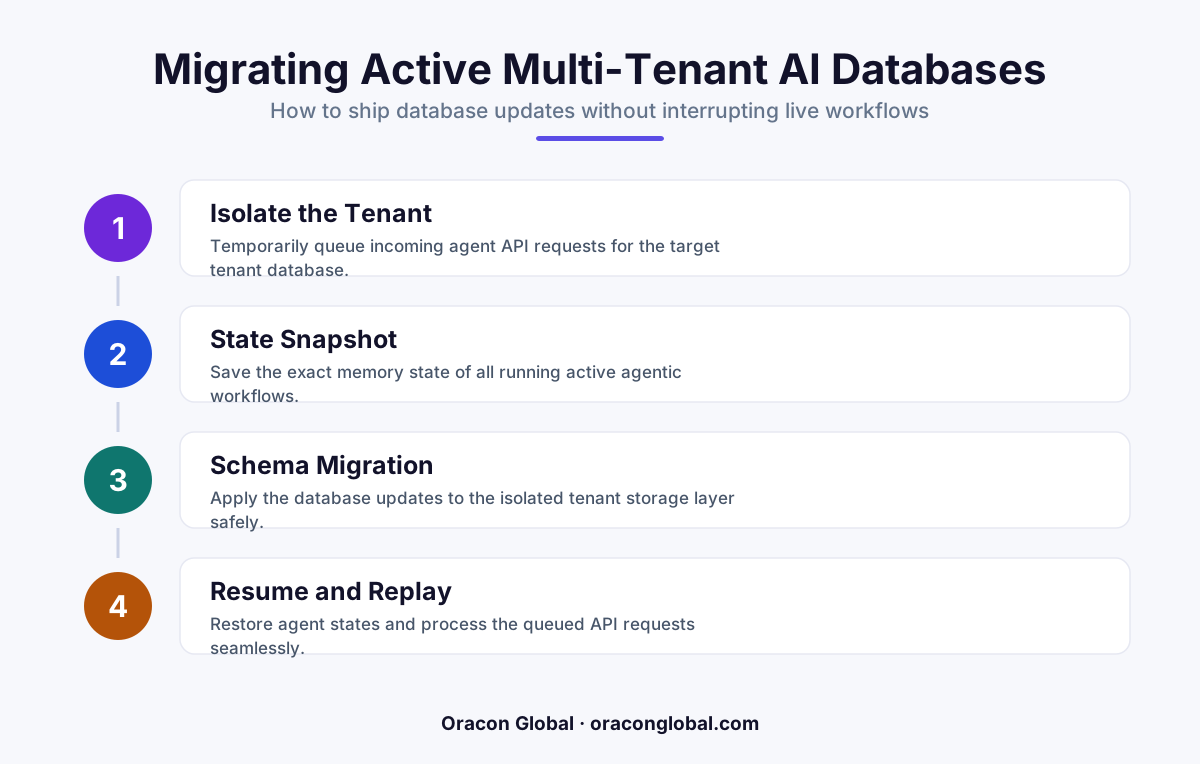
Traditional zero-downtime database migrations fail when AI agents run long, multi-step LLM loops that span several minutes. By decoupling the active agent execution state from the raw relational schema and utilizing a dual-write buffer queue, you can update your database structures without dropping live agentic transactions.
In a standard B2B SaaS platform, a database migration is a well-understood engineering task. You write a script, run it during a low-traffic window, and rely on blue-green deployments or rolling updates to shift users from the old schema to the new one. Because typical HTTP requests last only a few hundred milliseconds, the transition is almost instant and invisible to your customers.
But when you build an AI SaaS platform where autonomous digital employees run complex, multi-step workflows, the standard playbook falls apart. An AI agent does not work in milliseconds. It might spend three minutes querying an external API, running a retrieval-augmented generation loop, waiting for an LLM response, and writing a series of updates back to your database.
If your system pushes an AI SaaS database migration mid-way through that three-minute run, the schema change will break the active connection. The agent will attempt to write data to a column that no longer exists, or fail to provide a newly required field. The result is a broken workflow, lost tokens, and frustrated tenants. To prevent this, you need a custom migration engine built specifically to handle multi-tenant database migration safety without stalling agentic workflow state progression.
The Core Challenge: Long-Running Agentic Transactions
Traditional zero-downtime migrations rely on the assumption that database locks are brief. AI agents break this assumption entirely. Because agents execute logic in loops—often making multiple sequential decisions based on the database state—they require a stable schema for the entire duration of their run.
If you force a database schema update SaaS transition while an agent is on step four of a seven-step procurement loop, the database structure changes underneath the running code. This introduces several critical failure points:
- State Serialization Failures: The JSON payload the agent is constructing in memory no longer maps to the target table schema.
- Deadlocks: The migration script attempts to lock a table while an active LLM call is taking fifteen seconds to resolve, causing the migration to time out or freeze the entire app.
- Data Corruption: The agent writes a partially completed transaction using deprecated logic, leaving the tenant's workspace in an inconsistent state.
Step 1: Decouple Agent Execution Memory from Relational Schemas
The first rule of building a resilient migration engine is to ensure that active agent runs never communicate directly with your raw, evolving relational tables. Instead, active agent memory must be written to a dedicated, schema-agnostic state cache.
By using a fast, document-based key-value store for active runs, the agent can write its intermediate steps, tool call logs, and context windows as raw JSON. Once the entire multi-step agent workflow is 100% complete, a single deterministic database transaction writes the finalized results back to your core relational PostgreSQL or MySQL database. This minimizes the active write window from minutes down to milliseconds, making it much easier to coordinate zero-downtime database updates.
Step 2: Implement a Versioned State Router
To safely migrate schemas while agents are running, your custom migration engine must support versioned routing. Every tenant database and every active agent session must carry a schema version header.
When you deploy a new database update, your backend should run both the old schema and the new schema concurrently. This is often achieved using view-swapping or schema-shadowing in your database cluster. The versioned state router handles traffic based on simple, deterministic logic:
The Routing Lifecycle
- Active Agent Check: Before executing a new step, the orchestrator checks the agent's initial version tag (e.g., v1.2).
- Target Schema Alignment: The router directs all read and write queries for that specific agent session to the v1.2 schema views, ignoring the newly deployed v1.3 tables.
- New Session Initialization: Any brand-new agent workflow initialized after the migration deployment is automatically routed to the v1.3 schema.
- Graceful Deprecation: Once all active v1.2 agent runs drop to zero, the migration engine safely tears down the legacy views.
Step 3: Build a Dual-Write Buffer Queue
For migrations that involve structural changes—such as splitting a single customer table into separate tenant profiles—versioned routing alone is not enough. You must ensure that writes occurring during the migration transition are mirrored across both environments without risking data loss.
This is where a dual-write buffer queue comes in. Instead of writing directly to the database, your agent's finalized state is pushed to an event queue. A database sync worker reads from this queue and writes to both the legacy tables and the new tables simultaneously. If the new schema write fails because the migration is still running, the queue retries the message until it succeeds, guaranteeing eventual consistency across both versions.
Designing for Multi-Tenant Isolation
In a multi-tenant SaaS environment, you cannot afford a migration failure in Tenant A to corrupt or slow down the database for Tenant B. Your custom migration engine should run migrations sequentially, tenant by tenant, rather than applying a massive global lock across the entire system.
By isolating tenant databases—either logically through row-level security policies or physically through separate database schemas—your migration engine can queue updates. If a migration fails for a tenant with highly complex legacy data, the engine automatically rolls back that specific tenant's schema while leaving the rest of your customers running smoothly on the updated software version.
A Smarter Approach to AI Infrastructure
Building a custom migration engine that protects your agentic workflows requires a deep understanding of both modern database administration and real-world AI runtime behaviors. Off-the-shelf framework tools are rarely designed to handle transactions that span minutes of LLM processing time.
At Oracon Global, our senior in-house engineering team designs and builds highly resilient AI-native ERPs, scalable SaaS backends, and custom workflow automations that keep your business operations running without interruption. We write clean, high-performance code, and our clients retain 100% ownership of their intellectual property.
If you are ready to scale your AI SaaS platform with a robust production-grade architecture, contact Oracon Global today to discuss your development goals.
Frequently asked questions
Why do traditional zero-downtime migration strategies fail with AI agents?
Standard migrations assume web requests are short-lived. AI agent workflows can take minutes to complete multiple LLM steps, API calls, and tool executions, meaning a schema change mid-run will break the active agentic state.
What is a dual-write buffer queue in AI database engineering?
It is a temporary storage layer that records state changes during a database migration, ensuring that active agents can write to both old and new schemas simultaneously without failing.
How do you handle schema changes when an AI agent is mid-run?
We isolate the running agent's memory payload in a dedicated state-cache layer, allowing it to complete its multi-step loop using its starting schema version before gracefully shifting to the updated structure on its next run.
Can we use standard object-relational mapping tools for this?
Standard ORMs struggle with the dynamic, long-lived nature of agentic transactions. A custom migration engine handles versioned state routing far more reliably than basic out-of-the-box library migrations.
Read next
Beyond Chatbots: How to Build AI Agents That Actually Do Work for Your Business
Most businesses use AI to answer questions. Here is how to build custom AI agents that actually take action, connect to your internal tools, and handle complex workflows.
Beyond the Wrapper: How to Build Custom AI Agents for Business That Actually Work
Many businesses invest in basic AI wrappers only to find they lack the security and context needed for real work. Here is how to build custom AI agents that integrate deeply with your workflows and databases.
Enterprise AI Maintenance Costs: Budgeting for Year Two and Beyond
Building an AI system is only half the battle. Discover the practical, ongoing operational costs of enterprise AI, including token management, model drift, and continuous security audits.
Oracon Global builds production-grade AI agents, automation and apps — and you own the code and IP. Tell us what you want to automate.
Book a call →See our work