

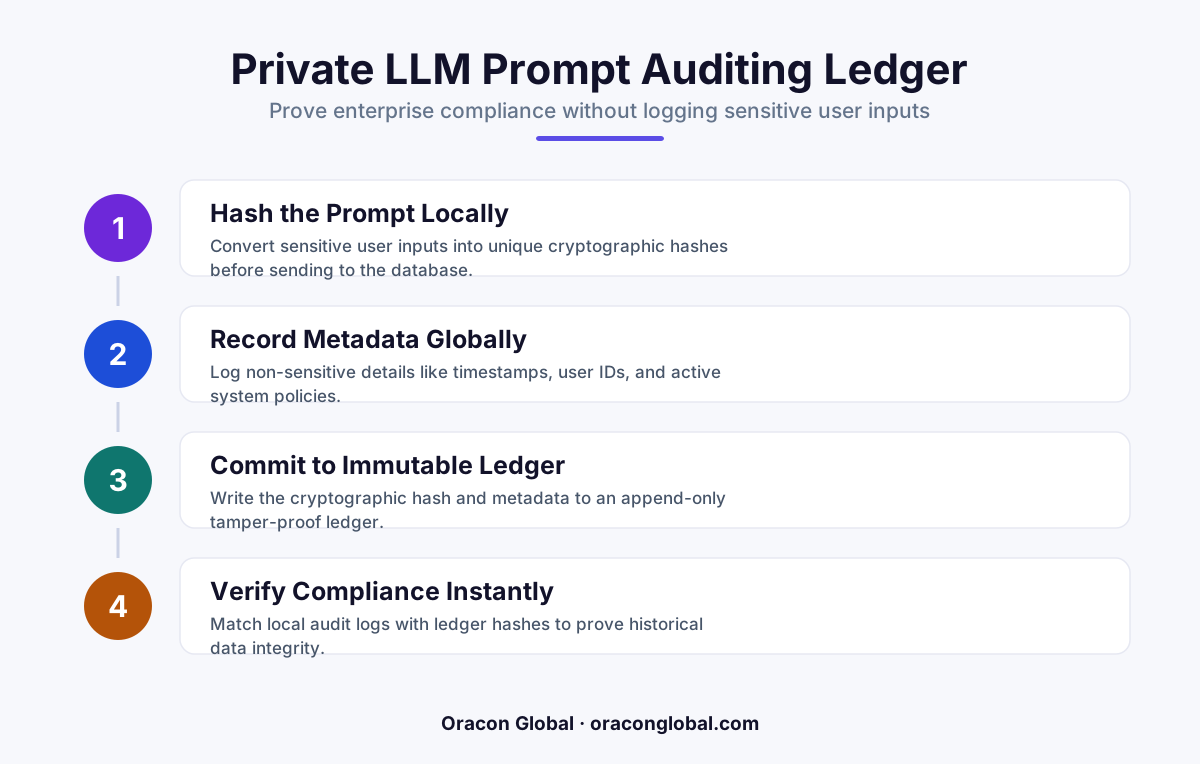
A cryptographic prompt auditing ledger allows enterprises to verify that AI agents followed compliance guardrails without storing the actual prompts or responses. By saving cryptographic hashes and execution metadata instead of raw text, businesses can satisfy regulators while ensuring absolute data privacy.
Enterprise operators face a difficult paradox when deploying production AI agents. On one hand, legal and compliance teams demand a complete audit trail of every prompt and response to ensure regulatory alignment. On the other hand, internal privacy policies and data regulations forbid logging raw inputs that contain sensitive customer information, proprietary IP, or personally identifiable information (PII).
Storing these conversations in plaintext databases is a massive liability. If a database is compromised, years of confidential business conversations are exposed. However, if you log nothing, you cannot prove to auditors that your AI systems are safe, unbiased, and operating within corporate guardrails. The solution is a cryptographic prompt auditing ledger—an architecture that proves AI enterprise compliance using zero-log AI auditing principles.
The Core Problem with Standard LLM Logs
Most traditional application logging frameworks capture everything. When a user interacts with a customer support agent or an internal database assistant, the server logs the full JSON payload, including the exact prompt and the model’s response. While this is helpful for debugging, it creates a dangerous honey pot of sensitive data.
Consider a healthcare application. If a doctor inputs patient symptoms to draft an insurance appeal, logging that raw prompt violates strict medical privacy standards. If your legal team needs to verify that the AI is not leaking internal medical secrets, how do they verify the safety of that interaction without reading the sensitive health data itself? A secure AI architecture must separate the verification of compliance from the storage of raw data.
How a Cryptographic Prompt Auditing Ledger Works
Instead of saving raw text to a central database, a cryptographic auditing system logs the mathematical proof of the compliance check. This approach relies on one-way cryptographic hashing algorithms, such as SHA-256. Once a string of text is hashed, it cannot be reversed to reveal the original words, but any party with the original text can run the hash function again to verify that it matches the ledger entry exactly.
The lifecycle of a secure, zero-log prompt transaction follows a structured pipeline:
- Local Interception: The system captures the incoming user prompt at the API gateway layer before it reaches the large language model (LLM).
- Real-Time Compliance Evaluation: Local regex filters, semantic routers, and classification models analyze the prompt for PII, toxic language, or policy violations. This evaluation yields a simple boolean result (e.g.,
compliant = true). - Cryptographic Hashing: The system generates a SHA-256 hash of the exact prompt text. It also generates a hash of the response once the LLM generates it.
- Metadata Assembly: A ledger payload is constructed containing only metadata: the timestamp, the prompt hash, the response hash, the compliance evaluation state, and a digital signature from the auditing microservice.
- Immutable Logging: This metadata packet is written to an append-only database or ledger. The raw prompt and response are immediately discarded from application memory.
The Step-by-Step Architecture for Zero-Log AI Auditing
Building this system requires a clear separation of concerns between your application frontend, your compliance validation layer, and your database storage.
1. The Gateway Sanitizer
Before any prompt is sent to the LLM or evaluated for compliance, it must pass through an in-memory sanitization layer. This layer identifies obvious PII (like credit card numbers or Social Security numbers) and masks them. The masked version of the text is what is used for the downstream compliance checks, ensuring that even the hashed data represents clean, compliant structures.
2. The Compliance Validator
This microservice runs local, high-speed checks. Because you want to avoid sending data to external APIs for the audit itself, we use lightweight local classification models. These models evaluate if the prompt aligns with corporate policies, outputting a clear metadata object containing the evaluation scores and the rules applied.
3. The Hash and Sign Service
Once the validation is complete, the original prompt is passed to a hashing service along with the validation metadata. The service combines the prompt string, the metadata, and a secret salt key, then hashes them together. This ensures that an external actor cannot guess the original prompt by simply testing common phrases against the ledger hashes.
"By logging only hashes and compliance metadata, enterprises can confidently hand audits over to external regulators without exposing a single word of customer conversations."
How to Verify Compliance During an Audit
When an internal team or external regulator asks to verify that a specific customer interaction was compliant, you do not need to show them a database of raw text. Instead, you use a verification protocol.
The customer or auditor provides the original, disputed prompt. You pass that prompt through the exact same local sanitization and hashing process using your secure system salt. If the resulting hash matches the hash recorded in your immutable ledger on that specific date and time, you have mathematical proof that:
- The prompt provided is indeed the one that was processed by the LLM.
- The compliance engine evaluated this exact prompt as safe at the time of execution.
- No tampering with the logs has occurred since the transaction was recorded.
This provides an absolute, unalterable proof of LLM data privacy and operational compliance without keeping a single byte of sensitive text on your servers.
Key Benefits for B2B Enterprises
Adopting a cryptographic approach to AI monitoring transforms how compliance-sensitive industries handle modern technology stacks:
- Zero Liability: If your logging database is breached, hackers find only metadata, timestamps, and irreversible SHA-256 hashes. Your customers' actual data remains completely safe because it was never saved.
- Regulatory Compliance: This framework satisfies rigorous global standards such as SOC 2, HIPAA, and GDPR by proving that security controls are active on every transaction without storing protected data.
- High-Speed Operations: Cryptographic hashing and metadata logging require minimal CPU overhead, ensuring your live AI applications remain fast and responsive for end users.
Partner with Oracon Global for Secure Enterprise AI
Building secure, enterprise-grade AI architectures requires deep engineering expertise. At Oracon Global, our senior in-house team builds highly secure AI agents, workflow automations, and custom enterprise systems tailored for compliance-heavy industries. Every solution we build is delivered with 100% code and IP ownership for your business.
If you want to deploy production-ready AI applications that meet strict security standards, contact Oracon Global today to discuss how we can design a secure AI pipeline for your business.
Frequently asked questions
What is a cryptographic prompt auditing ledger?
It is a secure logging system that records cryptographic hashes of AI prompts, responses, and compliance check states instead of storing the actual sensitive text.
How do you prove compliance without looking at the raw logs?
By running the input through a local validator first, hashing the approval state, and recording the hash on an immutable ledger that can be verified later.
Does this architecture slow down LLM response times?
When built with a fast hashing function and an asynchronous queue for ledger writes, the latency impact on the user experience is negligible.
Can this replace traditional security tools?
It complements them by providing an unalterable, audit-ready record of compliance actions specifically designed for AI-native workflows and data privacy.
Read next
Beyond Chatbots: How to Build AI Agents That Actually Do Work for Your Business
Most businesses use AI to answer questions. Here is how to build custom AI agents that actually take action, connect to your internal tools, and handle complex workflows.
Beyond the Wrapper: How to Build Custom AI Agents for Business That Actually Work
Many businesses invest in basic AI wrappers only to find they lack the security and context needed for real work. Here is how to build custom AI agents that integrate deeply with your workflows and databases.
Enterprise AI Maintenance Costs: Budgeting for Year Two and Beyond
Building an AI system is only half the battle. Discover the practical, ongoing operational costs of enterprise AI, including token management, model drift, and continuous security audits.
Oracon Global builds production-grade AI agents, automation and apps — and you own the code and IP. Tell us what you want to automate.
Book a call →See our work